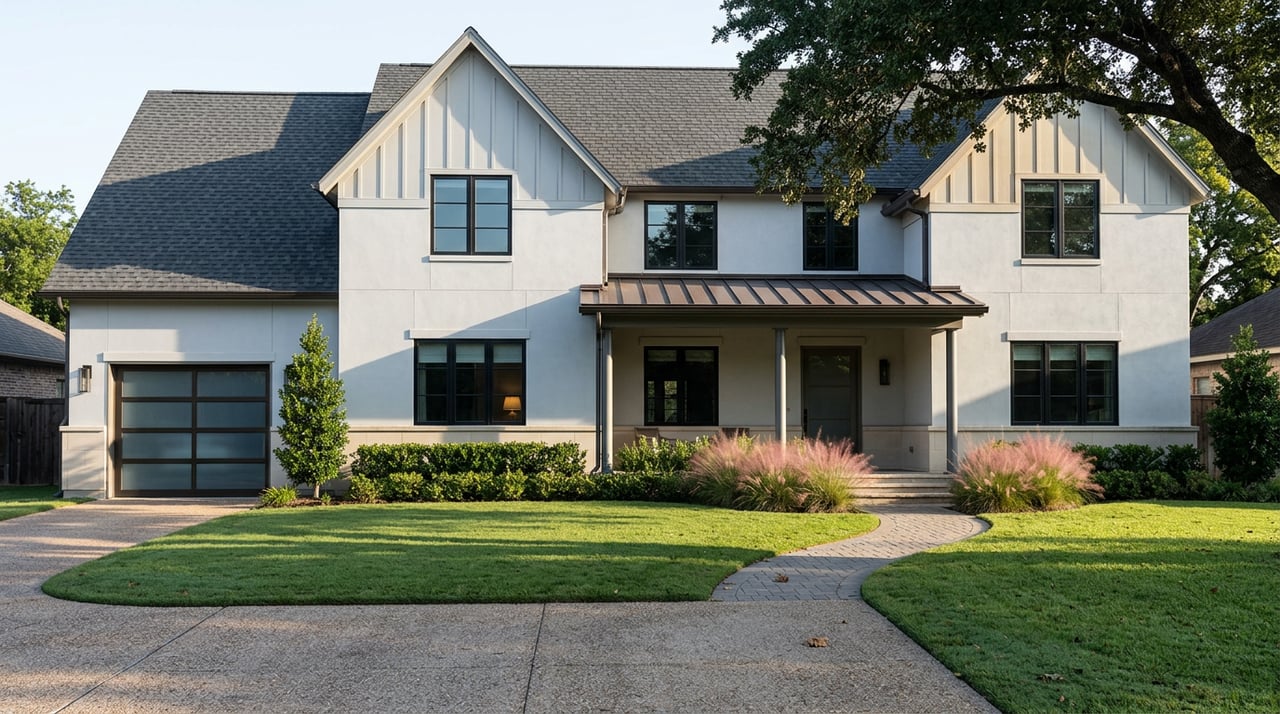
Two buyers toured Bridgeland the same week this summer, working with roughly the same budget. One walked into a Highland Homes model in Prairieland Village and left with a contract at $478,990, after $20,000 in design center credits and a rate buydown got folded into the deal. The other made an offer on a five-year-old resale in Parkland Village listed at $475,000 and closed at $456,000. Same price range. Same community. Two completely different negotiations, and neither buyer walked away with the number they thought they were getting.
That gap is not a fluke of timing or a particularly sharp negotiator on one side. It is how Bridgeland's pricing actually works right now, and it catches almost every buyer who assumes a list price means the same thing whether the sign in the yard says "David Weekley" or "For Sale by Owner."
The list price on a new build already has the negotiation built in
Ask a builder's sales office in Bridgeland to come down on price and you will usually get a polite no. That is not stubbornness. It is structure. Recent analysis of Bridgeland listings on HAR found that builder concessions, rate buydowns, design center credits, and closing cost contributions typically distort the transacted price by 4 to 7 percent relative to the advertised base price. In plain terms, the discount you would normally negotiate on a resale has already been baked into the deal before you ever sit down at the table. The number on the sign is closer to a final offer than an opening one.
That is worth sitting with for a moment.
A builder's list price and a resale seller's list price are answering two different questions. One is telling you the final number after incentives. The other is telling you where negotiation starts.
Bridgeland's builder incentives shift by season and by builder, and a look at Bridgeland's own builder incentives page on any given week shows offers ranging from design center credits to closing cost contributions to promotional financing rates. The specifics move. The mechanism does not. When a builder advertises $10,000 or $15,000 toward closing costs, that is not a discount waiting to be negotiated further. It is usually the extent of what is on the table.
Resale in Bridgeland is still a negotiation, not a formality
Contrast that with resale. A recent read of Bridgeland's active resale market put the current sale-to-list ratio at 96.08 percent, meaning homes are closing, on average, a few percentage points below what they were asking. That is a real, transactable gap. It means a resale seller's number is a starting point, not a settled one, in a way a builder's number typically is not.
So when a buyer compares a $475,000 new construction listing to a $475,000 resale listing and assumes they are choosing between two equally negotiable prices, they are missing the actual mechanics. The new build's $475,000 has already had its incentives applied. The resale's $475,000 likely has 3 to 4 percent still on the table if the comps support it.
This matters most for buyers trying to stretch a budget. If you are working with a hard ceiling, a resale listed at your number may actually close under it. A new build listed at your number will likely close at it, incentives and all, because the builder has already priced in the room to negotiate on its end, not yours.
The village you buy in changes the bill long after closing
The second piece of Bridgeland's pricing puzzle has nothing to do with what you pay at closing and everything to do with what you pay every year after.
Bridgeland is organized into four villages, and they are not the same age. Lakeland Village is the original section and is now largely built out and established. Parkland Village followed. Creekland Village opened in fall 2023 and borders Cypress Creek. Prairieland Village, west of Grand Parkway, is the newest and currently has the most active new construction, with Highland Homes and David Weekley building on 40 and 65-foot lots and Partners in Building running a model home for semi-custom product.
Each village sits inside its own Municipal Utility District, and each MUD carries its own bond debt for the roads, water, and drainage infrastructure that had to go in before homes could be built. That debt gets paid down over time through property taxes, which means older, established villages like Lakeland have retired more of their bond debt than a village like Prairieland, where the infrastructure is newer and the bonds are earlier in their repayment schedule.
The practical result: combined property tax rates across Bridgeland typically run between roughly 2.6 percent and 3.4 percent of assessed value, and where a given section falls in that range depends heavily on which MUD it sits in and how far along that district is in retiring its debt. Two homes priced identically at closing, one in Lakeland and one in Prairieland, can carry a materially different tax bill for years, simply because of which village's infrastructure debt you are helping pay down.
This is not a reason to avoid the newer villages. Prairieland and Creekland are where most of the active building is happening right now, and they sit closest to Bridgeland Central, the 925-acre urban core that has been adding real infrastructure of its own. An H-E-B opened at Village Green in late 2024. One Bridgeland Green, the community's first mass timber office building, opened in November 2025. Chevron has acquired more than 77 acres nearby for future commercial use, and in February 2026 the Houston Texans, Harris County, and Howard Hughes announced Toro District, an 83-acre sports and entertainment development planned within Bridgeland Central, with the Texans' new headquarters and practice facility expected to open by 2029. That is real momentum, and it is concentrated closer to the newer villages carrying the higher tax rates. Whether that tradeoff is worth it depends on how much weight a buyer puts on proximity to what is being built next, not on which number looks better in isolation.
What to actually ask for before you compare two Bridgeland prices
Given how much the same list price can hide, a buyer comparing homes across Bridgeland is better served asking for the underlying numbers than trusting the sticker.
- Ask the builder for a full concession breakdown, not just the headline incentive. A $15,000 closing cost credit and a $15,000 design center allowance are not interchangeable, and the base price before either one is applied tells you what the home is actually worth stripped of the current promotion.
- Pull the MUD bond schedule for the specific section, not just the village name. Bond debt retires over decades, and a title commitment will list every district attached to a lot along with where that district sits in its repayment timeline.
- Compare resale closings, not resale list prices. A recent sale-to-list ratio near 96 percent tells you the range to expect, but the comparable closings for the specific street or section are the number that actually matters when you write an offer.
None of this requires walking into a negotiation blind. It requires knowing which questions a builder's sales office is not going to volunteer, and which numbers a resale listing does not print on the flyer.
FAQ
Does the MUD tax rate ever go down? Yes, gradually. As a district retires its bond debt, the portion of the tax rate tied to that debt decreases. The school district and county portions of the bill do not follow the same schedule and typically remain more stable.
Is new construction ever actually negotiable in Bridgeland? Occasionally, particularly on inventory homes a builder is trying to move before a fiscal quarter closes. But the more common lever is an added incentive rather than a reduction in the listed price itself.
Which villages are still actively building? Prairieland Village and Creekland Village are the most active construction phases right now. Lakeland and Parkland are largely established, though resale and occasional infill activity continue there.
Do all Bridgeland villages carry the same property tax rate? No. Rates typically run between roughly 2.6 percent and 3.4 percent of assessed value depending on the section and its MUD's bond repayment stage, with older villages generally at the lower end.
If you are weighing a new build against a resale in Bridgeland, or trying to figure out which village actually fits your budget once the tax bill is factored in, that is exactly the kind of comparison worth doing before you write an offer, not after. Travis Harris has spent years walking Houston-area buyers through exactly this kind of decision. Let's Connect.
This article is general information, not legal, tax or financial advice. Consult a qualified professional about your situation.